
Polk County Bench Warrants Explained
A bench warrant is court process tied to a person's failure to meet a court obligation. In Polk County, missed traffic or Class C appearances often lead to JP or municipal-court questions. A missed setting, unpaid fine, or failure to comply may lead to a capias or another court process. The label depends on the case and law that applies.
Do not assume every missed appearance produces the same order. Ask the court whether the file shows a bench warrant, capias, capias pro fine, or another action, and what the judge requires next.
Polk County Capias Pro Fine Rules
Texas Code of Criminal Procedure Chapter 45A governs lower-court criminal procedure, including capias pro fine process in JP and municipal matters. A capias pro fine concerns unpaid court-ordered fines or costs; it is not simply another name for every arrest warrant.
The Chapter 45A text is the state source. Polk's four JP courts and city courts keep their own case records, so ask the named court what payment or hardship procedure applies.
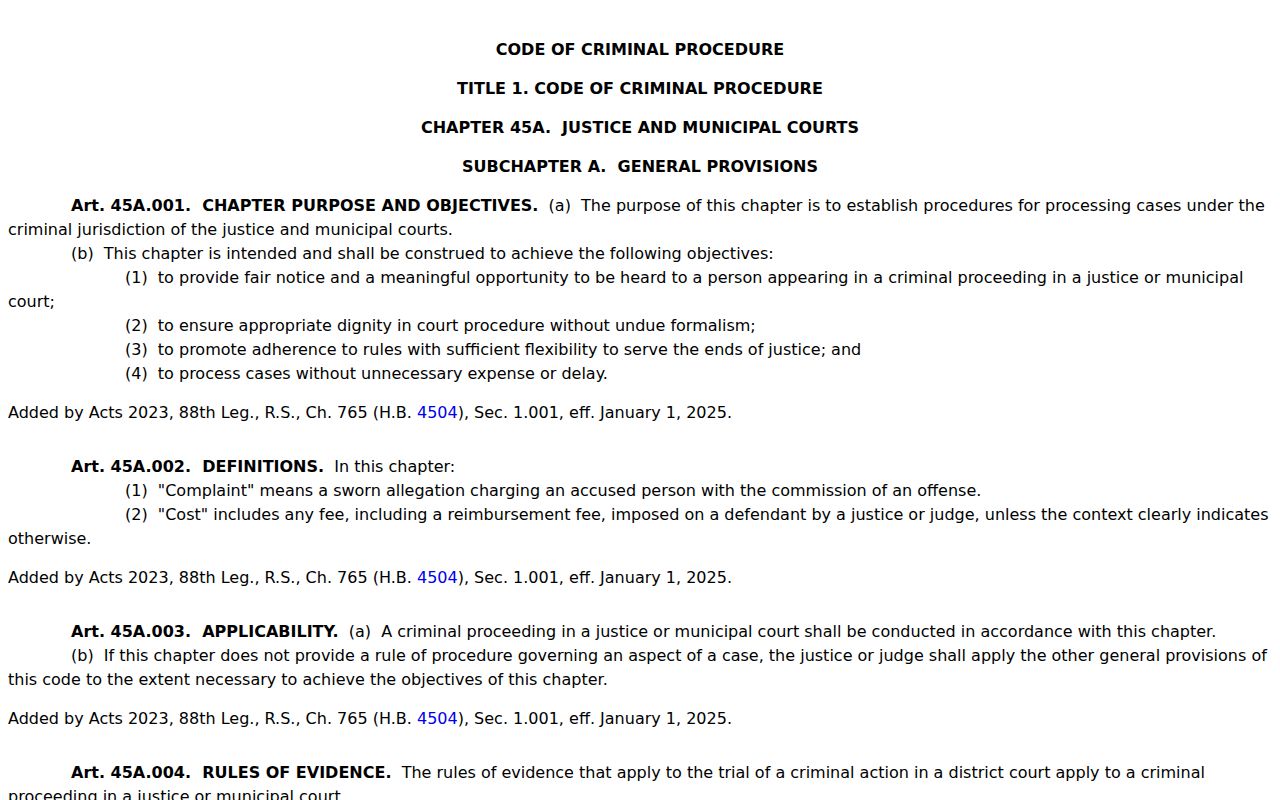
The statute image is a legal reference, while the court clerk confirms how the rule applies to a particular citation.
Polk County's JP3 Class C plea form illustrates why the issuing court matters: it presents response choices such as payment, a plan, alternative means, deferral, trial, and a 30-day request. Its additional fee instructions apply to that form and case route. They do not establish a universal fee or remedy for a capias issued by another JP or municipal court.
How Polk County Bench Warrants Are Issued
The judge or magistrate in the case court decides what process follows a missed duty. For lower-court fines, Chapter 45A includes capias pro fine procedures. The exact notice, setting, payment, or hardship option depends on the court and case; Polk County did not publish one countywide notice schedule.
After issuance, the sheriff may enter some process in law-enforcement systems, but the court keeps the case file and controls changes. Call the issuing court to confirm what was signed and whether a new setting, bond, payment, or motion is required.
A missed setting, unpaid balance, and new criminal charge describe different underlying events, so a reader should not infer process from the word "warrant" alone. Ask the clerk to name the document and its issue date, then confirm whether an order or later disposition appears in that court file. An agency list can provide a lead, but only the issuing court can explain the court's entry and current response path.
Livingston and Onalaska Court Rules
Local forms show why one missed-date rule should not be copied across every court. Onalaska's response form warns that a call is not an appearance and says nonresponse can lead to a warrant. Livingston's FAQ says a payment plan or extension requires appearing before the judge.
Those are city-specific instructions. A Polk County JP citation or another city's case may use a different form and process. Read the court name on the paper and ask that clerk about the accepted response.
In Livingston, the FAQ directs extension and payment-plan requests to an appearance before the judge. In Onalaska, the form warns that a call is not an appearance and that no response may lead to a warrant. These details show why a missed setting needs a court-specific answer: the same step, such as leaving a voicemail, can have no effect on a deadline. Save the form version and ask the clerk to confirm receipt of anything submitted.
Bench Warrants and Arrest Warrants Compared
A bench warrant grows out of an existing court obligation. An arrest warrant is a probable-cause order tied to an alleged offense. The court level and response route differ. See the arrest-warrant explanation for felony and misdemeanor routing.
| Feature | Bench Warrant | Arrest Warrant |
|---|---|---|
| Trigger | Missed appearance, unpaid fine, or noncompliance | Probable cause of an offense |
| Who issues | Judge in the existing case | Magistrate or court on criminal process |
| Underlying file | Earlier case or citation | Complaint or charge being brought |
| Next step | Ask court about setting, payment, or recall | Ask counsel and court about bond or appearance |
No Polk County Bench Warrant Search
Research found no public countywide bench or capias list. The Sheriff's Wanted List is curated, and the county clerk indexes do not promise to show JP or municipal process. The absence of an entry is not an answer from the court that issued it.
Call the municipal or JP clerk named in the case, then use the sheriff's Warrant Division for operational routing. For a copy of an existing record, the county's public-information process is separate from a live case inquiry.
County clerks, JP courts, and municipal courts keep different records, while TCIC and NCIC are restricted to authorized users. If an index returns nothing, verify the court and spelling with the issuing clerk and ask whether a capias, bench warrant, or later order appears in the case.
Resolving a Polk County Bench Warrant
Contact the issuing court before paying or appearing. The clerk can explain accepted case procedures, while counsel can advise whether to seek a setting, file a motion, post bond, or arrange an appearance. No official countywide recall form or walk-in docket was located.
- Read the citation or case notice and identify the court and case number.
- Call the clerk and ask whether the court can confirm the process and current next step.
- Ask a lawyer about a motion to recall or quash, a bond, or an attorney-coordinated appearance.
- Follow the court's instructions on payment, a new setting, or the underlying case, then request written confirmation.
If a fine or cost is involved, confirm the balance and whether payment requires a judge's further order. Bond concerns release from custody, not recall of the case process. Keep the receipt, signed order, and any new setting notice as proof of the court's action.
Caution: Do not assume a bench warrant disappears with time or payment; ask the issuing court to confirm the case after each required step.
Polk County Recall Questions
No official motion-to-recall or surrender form was found. Ask the court which form or setting request it accepts, whether a judge must hear the request, and what proof shows that the order changed. A records clerk can explain filing procedure but cannot give legal advice.
A records request can obtain an existing docket entry or return, but it is not a motion to recall. Follow the clerk's procedure for a hearing, then keep the signed order or receipt and ask how the court records the change.
Finding the Court That Issued the Warrant
The court that set the obligation controls the case and any request to recall process. District felony records go to the District Clerk; County Court at Law misdemeanor records go to the County Clerk. A Class C or traffic citation names a JP precinct or city court.
Start with the court printed on the paper. If it is unclear, contact the sheriff's Warrant Division for routing, then call the court before making a trip. The county warrant lookup steps list the clerk and court channels.
The District Clerk handles district-court felony filings, the County Clerk routes County Court at Law records, and each JP keeps its own precinct docket. Municipal citations stay with the city court that issued them. A person who moved or received the ticket in a different town should not choose a court by residence or current address; the original court label is the most reliable starting point.
Which Polk County JP Precinct Applies
A citation or court notice should name the precinct. JP1 and JP4 are in Livingston, JP2 is in Onalaska, and JP3 is in Corrigan. The county JP directory lists contacts for each court; the county seat does not mean every lower-court case belongs to JP1.
For a JP3 Class C matter, the county's plea form lists options such as payment, a payment plan, alternative means, deferral, trial, and a 30-day request. Use that form only for its court and case type.
Precinct references help route a paper but do not identify its current status: JP1 is reached at 936-327-6841, JP2 at 936-646-3674, JP3 at 936-398-4114, and JP4 at 936-327-6865. Read the court label and precinct from the actual ticket before calling. If the case was transferred or the notice names a municipal court, ask that issuer instead of choosing the precinct based on where the person lives.